
Ville Kiiski | Semant.ai | March 2026 – Finnish version
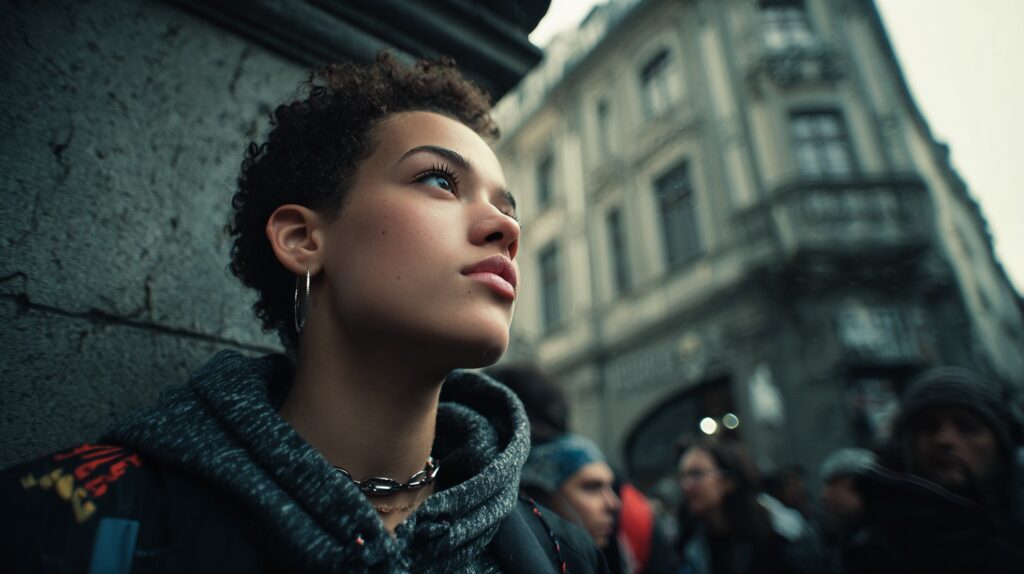
Half of young Finns view the world’s future with pessimism. Two newly published studies show that social media algorithms are one structural cause: they distort young people’s worldview, shut out civil society and produce systemic insecurity. The pattern is not uniquely Finnish. Regulation identifies the problem but does not build an alternative. At Semant.ai, we are trying to building one.
On March 10, 2026, two major studies were published on the same day. Together, they form a striking picture of the digital reality facing young Europeans. Finland’s Youth Barometer 2025 documents the symptoms. Sitra’s Algorithms and Democracy report reveals the mechanism. Combined, they confirm what many of us have suspected for years: current social media platforms do not merely reflect the world. They actively distort young people’s experience of it.
The question is no longer whether the problem is real. The question is what to do now.
The symptoms: pressure, pessimism, insecurity
The Youth Barometer 2025 surveyed 2,312 young Finns aged 15 to 29. The findings are unambiguous.
Seven out of ten young people experience pressure related to finding work. Half report pressure about their appearance and about being outgoing enough. Life satisfaction has declined from the previous year. And the share of young people who view the world’s future pessimistically has nearly doubled since 2021, rising from 28 to 50 per cent.
More than half are worried about climate change, but a third feel guilty about not doing enough. Of those experiencing guilt, only 13 per cent say it has actually driven them to act. The rest carry the burden without a channel for it.
The greatest sources of insecurity are the geopolitical situation, prevailing societal values and attitudes, and employment prospects. Insecurity among young people appears to be systematically increasing.
These are not isolated problems. They are the portrait of a generation that wants to act but feels stuck.
The mechanism: algorithms that do not listen
Sitra commissioned The Behavioural Insights Team and Bondata to conduct a large-scale audit of the political content encountered by 18-to-24-year-olds on Instagram, TikTok and X across Finland, France and Romania.
The results are significant.
Strongly right-wing content dominated young people’s feeds. Fifty-eight per cent of all politically classified content leaned right, compared with 26 per cent left and 16 per cent centrist.
This dominance persisted even when test profiles actively signalled interest in left-wing content. The algorithm did not listen.
In Finland, 44 per cent of young people who identify with the left reported that the content they received matched their views very poorly. Among those identifying with the right, only 5 per cent said the same.
The majority of problematic content did not violate platform community guidelines. Instead, feeds were saturated with unverifiable, opinion-based material: 67 per cent of all content. Not outright misinformation, but something harder to combat: a constant stream of emotional provocation without informational foundation.
Five per cent of political content was clearly AI-generated. Deepfakes of politicians and synthetic avatars disseminating hostile commentary. This is a growing trend that will accelerate.
Half of young respondents reported feelings of disappointment, fear, anger or sadness when encountering political and social discussions on social media.
Sitra’s researchers used a direct term for what is happening: enshittification. The systematic degradation of platform quality as user experience is sacrificed to engagement maximisation and monetisation.
A structural problem demands a structural response
The EU’s Digital Services Act identifies these algorithmic phenomena as systemic risks. That is an important regulatory framework. But regulation alone does not build an alternative. It can slow the deterioration. It cannot create something new.
What is needed is infrastructure. European digital infrastructure designed from fundamentally different premises.
This is the work we are doing at Semant.ai. We are building a European social media platform designed from fundamentally different premises.
We are not building a new TikTok with a European flag on it. We are not making a low-calorie version of an American platform. We are building European digital infrastructure for hybrid life: a world in which people, communities, events and local economies can function without an American or Chinese algorithm owning the encounter.
In practice, this means three things.
The first is genuine user control. No algorithm deciding on your behalf. No unpredictable feed that shifts without explanation. Sitra’s audit showed that user engagement signals had no consistent impact on the content delivered to them. In our model, the user defines what they want to follow and whom they want to hear from. It sounds simple, because it is. Current platforms have simply made it impossible.
The second is restoring civil society to the digital public space. Meta has effectively shut out large parts of the third sector by algorithmically classifying civic organisations’ communications as political advertising. The result: the very actors whose message carries the greatest societal value occupy the weakest position in digital space. Our opt-in model reverses this. Users themselves indicate that they want to hear from organisations, local actors and communities. The message becomes an invitation, not an interruption.
The third is connecting the physical and the digital in a way that produces agency. The Youth Barometer shows that young people draw support from personal relationships, not from platforms. They want to act but experience guilt over their passivity. Our solution connects digital community with physical encounters: art, events, local civic action. A platform that does not replace human relationships but strengthens them.
Why now
The timing is exceptional. The United States’ descent into unpredictability has forced Europeans to think about digital sovereignty with new urgency. The EU’s regulatory framework is maturing. The movement against the dopamine economy is gaining strength. And now we have empirical evidence that quantifies the problem in a way that did not previously exist.
Two studies, on the same day. One measures the symptoms, the other reveals the mechanism. Both point in the same direction: the current structure is broken, and it is harming precisely those in whose hands Europe’s future lies.
We do not claim it will be easy. But it is unquestionably worth the effort.
Semant.ai is building European social media where the human being is not a product but an active participant. If you agree and want to support us, or simply drop us a encouraging comment, please don’t hesitate to contact us at supporters@semant.ai
Sources: Youth Barometer 2025: ”Ihan paineissa.” State Youth Council, Ministry of Education and Culture, Finnish Youth Research Society. Published 10 March 2026. Algorithms and Democracy: How social media shapes young Europeans’ worldviews. Sitra, 2026. Published 10 March 2026.